
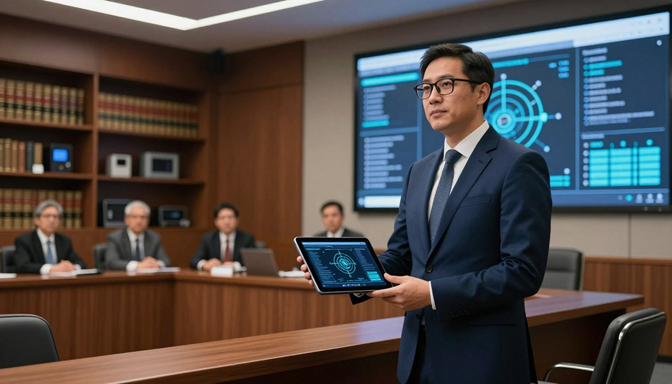
AI Expert Witness: Why Courts Need Specialists in AI Technology
Modern courts are grappling with a new wave of digital complexity. Judges and juries increasingly encounter cases where the outcome hinges on algorithmic outputs—systems that influence hiring decisions, financial lending, and criminal sentencing. Yet, most legal professionals lack the technical background to evaluate these systems critically.
This gap has created an urgent demand for a specialized professional: the AI expert witness. By bridging the worlds of machine learning and legal procedure, these experts ensure that courts receive accurate, impartial, and intelligible explanations of AI-driven evidence. Without them, legal teams risk misinterpreting data, overlooking model flaws, or failing to challenge the biased assumptions baked into automated systems.
Key Takeaways
- Technical Translation: Qualified AI expert witnesses translate complex machine learning data into plain language for judges and juries.
- Preventing Miscarriages of Justice: Clear, accurate explanations of automated systems prevent courts from accepting flawed algorithmic conclusions blindly.
- Litigation Advantage: Technical literacy and access to specialized experts have become a distinct competitive advantage for trial attorneys.
- Accountability: Rigorous expert testimony ensures that rapid digital innovation remains accountable under current legal frameworks.
The Rising Complexity of Artificial Intelligence in Litigation
Machine learning models are growing more sophisticated, and the legal system is struggling to keep pace. AI technology now generates evidence in a wide range of disputes—from employment discrimination claims to fraud investigations—and traditional courtroom procedures were simply not designed for it.
Consider the fundamental differences between conventional and AI-driven evidence:
| Feature | Traditional Evidence | AI-Driven Evidence |
| Source | Human testimony or physical documents | Algorithmic output and model data |
| Transparency | Highly visible and verifiable | Often opaque (“black box” logic) |
| Complexity | Low to moderate | Extremely high |
| Expertise Required | General legal/forensic knowledge | Specialized computer science insight |
Old frameworks struggle most with AI’s opacity. When a model produces a decision—denying a loan, flagging a résumé, or predicting recidivism—the underlying logic is rarely visible to outside observers. As AI litigation continues to expand, trial lawyers who cannot navigate this landscape will find themselves at a significant disadvantage.
Defining the Role of an AI Expert Witness
An AI expert witness helps legal teams interpret complex software systems within the evidentiary framework courts require. Their core function is to ensure that judges and juries understand the technical dimensions of a case well enough to reach a well-informed verdict.
Effective experts combine deep knowledge of machine learning with a firm grasp of evidence law and courtroom procedure. They examine algorithms, audit training data, and identify sources of bias or error—all while maintaining strict neutrality, as their primary duty is to the court, not to the party that retained them.
| Feature | Fact Witness | AI Expert Witness |
| Primary Focus | Factual observation of an event | Technical methodology and systems |
| Data Handling | Testimonial evidence | Algorithmic and dataset analysis |
| Role in Court | Recounting firsthand events | Explaining complex digital systems |
| Key Requirement | Personal knowledge of the facts | Demonstrated technical expertise |
The role goes beyond simple explanation. These professionals assess whether an AI system was deployed appropriately, whether its outputs are reproducible, and whether its design contributed to the legal harm at issue.
Intellectual Property Disputes Involving Generative AI
Few areas of law have been disrupted more visibly by artificial intelligence than intellectual property. Generative AI systems produce images, text, music, and code at scale—often drawing on vast datasets whose provenance and licensing status are hotly contested. When disputes arise, courts need expert guidance on two main questions: algorithmic bias and authorship.
Algorithmic Bias in Training Data
AI models can absorb and amplify biases present in their training datasets, producing outputs that reflect historical inequities rather than objective analysis. In IP litigation, this matters because a biased model may produce content that infringes on protected works in statistically predictable ways.
Identifying and quantifying that bias requires expertise at the intersection of computer science and law. Without an expert, neither the judge nor the jury has the tools to evaluate whether the training process was sound.
Authorship and Copyright Infringement
Copyright law is built on the assumption of human authorship. Generative AI complicates that foundation. When a system produces an image or text with minimal human direction, courts must determine whether the output qualifies for copyright protection and, if so, who owns it.
- Authorship Challenge: Traditional IP relies on human-centric creation. AI-driven IP involves autonomous generation, requiring an expert to define and quantify the actual human input.
- Infringement Tracking: While traditional infringement looks for direct copying, AI infringement often involves complex pattern matching, requiring experts to analyze the underlying code logic.
The Impact of AI-Generated Evidence on Courtroom Credibility
Generative AI has introduced a troubling dimension to evidentiary standards: the risk that digital media introduced as evidence has been wholly or partially fabricated. When synthetic content enters litigation, it can undermine the credibility of the entire evidentiary record.
Authenticating Digital Media and Deepfakes
Deepfake technology can manipulate audio and video with startling precision. Identifying manipulated media requires advanced forensic analysis—specifically, the detection of subtle artifacts that indicate machine-generated interference.
Without rigorous verification, sophisticated fabrications can bypass traditional scrutiny. Courts now rely heavily on specialists who can distinguish authentic recordings from synthetic media using a defensible, documented methodology.
Explaining Black Box Algorithms to Juries
Beyond visual evidence, “black box” algorithms present a separate challenge. These systems produce decisions through processes that are not transparent, sometimes even to their own developers. When juries cannot follow the reasoning behind an automated conclusion, skepticism and legal error follow.
Expert witnesses act as translators, breaking down technical jargon into concepts that are clear and relatable without sacrificing accuracy. Demystifying the black box is a prerequisite for fair adjudication.
Navigating the Daubert Standard for AI Testimony
The Daubert standard governs the admissibility of expert testimony in federal courts and many state jurisdictions. Under Daubert, an expert’s methodology must be scientifically valid, testable, peer-reviewed where possible, and accompanied by a known or estimable error rate. Applying this framework to AI systems raises unique hurdles.
Establishing Scientific Validity of AI Models
Courts scrutinize whether a model’s conclusions can be independently tested and verified. An expert who cannot explain the logic of their system—or who cannot account for its failure modes—risks having their testimony excluded. Transparency about methodology is the price of admission.
Peer Review and Error Rate Analysis
When the methods underlying an AI system have been vetted by independent researchers, courts assign that system greater credibility. Equally important is the honest disclosure of error rates. Experts who acknowledge the limitations of their tools, rather than overselling them, tend to be more persuasive and ethically sound.
Technical Concepts and Their Legal Impact
The most effective AI expert witnesses are skilled communicators who understand that a technically perfect analysis has no value if the jury cannot follow it. They anchor their testimony by translating abstract data concepts into clear legal impacts.
| Technical Concept | Legal Translation | Impact on Case |
| Algorithmic Bias | Systemic unfairness embedded in data | Establishes or refutes liability in discrimination |
| Black Box Logic | Unexplained decision pathway | Challenges the reliability of the evidence |
| Training Dataset | Historical information used to build the model | Validates or undermines overall model accuracy |
| Predictive Output | Forecasted behavioral conclusion | Informs risk assessment and damage calculations |
Common Legal Scenarios Requiring AI Technical Expertise
Liability in Autonomous Vehicle Accidents
When an autonomous vehicle is involved in a collision, determining fault requires dissecting the vehicle’s decision-making software. An expert examines sensor data logs, software update histories, emergency braking response times, and communication with external systems to establish whether the technology performed within acceptable parameters.
Data Privacy Breaches and Predictive Analytics
Companies using predictive analytics to model consumer behavior face growing legal exposure as privacy regulations tighten. When a breach occurs, or when a model is found to have made discriminatory predictions, courts must evaluate whether the data handling and algorithmic design met legal standards. Experts identify exactly where biased training data produced unlawful outcomes.
Ethical Considerations for AI Specialists
Technical competence alone is insufficient; AI expert witnesses carry significant ethical responsibilities. Because their testimony can tip the outcome of high-stakes cases, they must prioritize accuracy, transparency, and impartiality over advocacy.
- Data Privacy: Sensitive information handled during case preparation must be treated with strict confidentiality and in compliance with privacy laws.
- Complete Transparency: Experts must explain AI systems fully, avoiding selective data framing that could mislead the court.
- Bias Disclosure: Any biases identified in the systems being analyzed—or in the expert’s own methodology—must be proactively disclosed.
- Institutional Integrity: Honest, objective reporting builds trust in the legal system’s capacity to adjudicate technology cases fairly.
Preparing for Cross-Examination on AI Methodologies
Simplifying Complex Technical Concepts
Under cross-examination, clarity is an expert’s most important asset. The goal is not to impress the court with technical sophistication, but to ensure that the jury understands what the AI system did, why it did it, and what that means for the case. Real-world analogies and plain-language explanations consistently outperform technical jargon.
Defending Model Integrity Against Opposing Counsel
Opposing counsel will probe for weaknesses in training data, validation methodology, and the expert’s own qualifications. A well-prepared expert anticipates these lines of attack, remains composed, and anchors their responses in documented evidence and accepted industry standards. Consistency and logical coherence are the best defenses against aggressive cross-examination.
The Future of AI Litigation and Judicial Oversight
The integration of AI into litigation is not a passing trend. As machine learning systems take on greater roles in finance, healthcare, criminal justice, and employment, the volume and complexity of AI-related cases will continue to climb.
Effective judicial oversight will require judges who can evaluate AI evidence critically and legal teams that include professionals fluent in both technology and law. The expert witness remains central to that evolution.
| Evidence Type | Primary Source | Verification Method | Legal Complexity |
| Traditional Evidence | Human testimony / paper trails | Cross-examination / forensic auditing | Moderate |
| AI-Generated Data | Algorithmic output | Technical code audit / system logs | High |
| Predictive Analytics | Statistical models | Validation testing / error rate analysis | Very high |
How to Secure Qualified AI Testimony for Your Case
Evaluating Credentials and Industry Experience
Look for experts who combine academic credentials with hands-on experience deploying or auditing AI systems in real-world contexts. Review their publication history, prior testimony, and peer assessments. Prioritize candidates who have handled cases involving the specific technologies at issue—whether that is bias in predictive models, generative AI intellectual property disputes, or autonomous vehicle software.
The ability to explain complex systems in plain, persuasive language is just as important as technical depth. Always request writing samples, prior reports, or deposition transcripts before retaining an expert.
Contact Our Network for Specialized AI Support
Our network connects legal professionals with rigorously vetted AI expert witnesses across multiple specializations. Whether your case involves data privacy, autonomous systems, generative AI, or algorithmic bias, we can match you with a qualified specialist quickly.
- Phone: 800-529-5121
- Email: webadmin@lawsonline.com
Frequently Asked Questions
Why has demand for AI expert witnesses increased recently?
Machine learning and predictive software are now embedded across nearly every industry. As AI-driven decisions become the subject of litigation, courts need specialists who can explain and scrutinize these systems accurately. The growing use of large language models and automated decision platforms has made this expertise indispensable.
How does the Daubert standard apply to AI evidence?
Under Daubert, expert testimony must rest on a methodology that is scientifically valid, testable, and accompanied by a known error rate. For AI systems, this means the expert must be able to explain how the model works, demonstrate that it has been independently reviewed, and account honestly for its limitations.
What makes black box algorithms particularly challenging in court?
Many deep learning models produce outputs through complex neural networks that cannot be easily traced or explained. Juries cannot evaluate what they cannot understand, so an expert’s ability to translate that internal logic into accessible language is critical to the fairness of the proceeding.
Can an AI expert identify bias in training data?
Yes. Examining training datasets for systematic bias is one of the core functions of an AI expert witness. This is especially vital in discrimination claims, where a model trained on historically skewed data may produce outcomes that disadvantage protected groups.
How is authorship determined in generative AI copyright disputes?
Courts examine the degree of human creative input involved in producing the final work. An expert reviews the prompts used, the model’s generative process, and any post-generation edits to help the court apply copyright doctrine to the technical facts.
What role does an expert play in autonomous vehicle accident cases?
The expert reviews sensor logs, software version histories, and system telemetry to determine whether the vehicle’s AI performed as designed. They help the court understand whether a crash resulted from a software defect, a hardware sensor failure, or driver intervention.
How should an expert prepare for cross-examination?
Preparation centers on anticipating challenges to methodology, data quality, and the expert’s own qualifications. The expert must be ready to explain every aspect of their analysis in plain language and remain calm and consistent when pressed by opposing counsel.
How can a legal team secure qualified AI testimony for an upcoming case?
Legal teams should look for candidates with industry experience and tech-law understanding. For help, they can call 800-529-5121 or email webadmin@lawsonline.com. This way, they can find a professional who fits their case needs.
About this Article
This article was written exclusively by AI with instructions provided by Vincent Pundt a human to generate an article based on the The following statement “The need for an AI expert witness who specializes in AI court room testimony on how AI functions and its Role” The objective of this article was to utilize SEO (Search Engine Optimization) key words and phrases so that this article would show up on the top of search engines and search results more prominently when humans where asking questions related to “AI expert witness”. The idea was to utilize AI language model processing to appear friendly to AI search systems. This idea was anticipating that AI would create an article with a higher rate of understanding on how AI search engines work. The goal of the article is to attract potential expert witness to promote themselves on the National Database of Legal professional Lawsonline.com as exclusive experts in the world of AI (artificial intelligence) and the understanding of Natural Language Processing (NLP) and Large Language Models (LLMs).
The need for Expert witness in the AI world is great. More and more cases are starting to arise where AI technologies are being involved. So understanding this impact on individual work product and reputation is large.
To generate this article the first results were originated by SEOWritingAI. Which uses DeepSeek for cost effective results. The article was then given to another AI to be edited which was Claud.ai which is supported by Anthropic. After the results where refined by Claud.ai it was given a final review by Gemini which is Google. To illustrate how competitive and expansive the AI world is becoming here is a list of some of the Major Players in the AI world. These are Labs/ company that are working on the AI Technology.
Company(Creator) | Core Model (Brain) | Primary Consumer App | Core Model Access Style
OpenAI | GPT-40 / GPT-5 | ChatGPT | Closed/ Proprietary
Antrhopic | Claude 3.5 /Claude 4 | Claude.ai | Closed/ Proprietary
Google DeepMind | Gemini 2.5 / Gemini 3/.5 | Google Gemini | Closed/ Proprietary
DeepSeek |DeepSeek-v3 /R1 |DeepSeek App | Open-Weights
Meta | Llama 3/ Llama 4 | Meta AI (on Instagram/FB) | Fully Open-Weights
xAI | Grok3 /Grok 4 | X (formerly Twitter) App | Closed / Proprietary
Microsoft | Phi-4 /Copilot Models | Microsoft Copilot | Mixed (Phi is Open)
Mistral AI | Mistral Large / Mixtral | Mistral le Chat | Mixed/ Open-Weights
Alibaba | Qwen 2.5 / Qwen 3 | Qwen Chat | Open-Weights
Cohere | Command R/ R+ | Cohere Dashboard (Enterprise)| Closed/ Enterprise API
These are the Labs creating the different language model programs for the AI to function. I am not an expert on this field and the number of the different organizations participating in AI is growing so that is why I am posting this article and asking the question are there individual who are comfortable enough with AI technology and the different companies creating and working with AI to be an expert witness for the courts to interpret the impact of this new technology. Please reach out to us if you are Email: webadmin@lawsonline.com
Here is the original articles created by SEOWritingAI supported by DeepSeek
Here is the edited article created by Claud.ai which is supported by Anthropic



0 Comments