
Adoption Isn’t A “Coming” Issue – It’s Already Happening
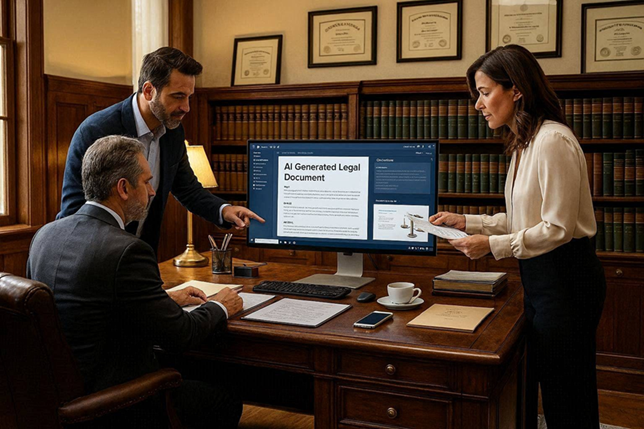
A managing partner at a five-attorney law firm meets with a potential new client. The meeting goes very well — great fit, within their budget range, a common area of law they have handled many times. The potential client then asks a question that was not on the partner’s prepared list (as they did not prepare for this type of question) — “How is your firm utilizing AI in cases such as this?” The honest response would have been something akin to “We are looking into it.” The partner did not give this response. Instead, he gave a vague response stating — we are just trying to stay current with the technology and did not provide anything else specific. The potential client nodded his head, the meeting concluded, and neither party knew if the response given by the managing partner caused the firm to lose the opportunity. That unease is the reason. Not because the firm may have lost the business; rather, the fact that the prospective client asked the question at all before doing any actual work is the problem. Before one year ago — questions regarding utilization of AI were rare except for when large institutions with sophisticated legal operations groups were considering hiring law firms. Currently, prospective clients of smaller and boutique law firms are asking similar types of questions during the initial meetings — prospective clients who increasingly expect there to already be a “yes,” and an explanation of “here’s how.”There is currently no longer a hypothetical issue as to whether AI will become relevant to law firms of these sizes. It already is. The issue that is worthy of discussion is not whether adoption will happen, but rather how late a firm is in terms of adoption, and what can be done to correct its lack of adoption.
The Triggering Event — Anthropic’s 12 Practice Area Plugins for Legal Workflows in Claude
Anthropic launched Claude for Legal in May 2026. To sit back and consider the magnitude of this announcement for a moment. The release included 12 practice area plugin options for legal work — including corporate and regulatory issues, litigation and intellectual property — plus greater than 90 named workflow agents and greater than 20 data connectors to link Claude with existing legal technologies that firms rely upon each day — contract life cycle systems, research platforms, document management, e-discovery, data rooms and firm-specific precedent libraries. One of those details is important, and could seem trivial at first glance. For years, the model utilized to build most legal technology has remained invisible in the background — present in the tools lawyers utilize every day — yet always remaining unseen in the process of completing their tasks. Claude changes this dynamic. With established legal technology platforms becoming connected to Claude (versus Claude being integrated into legal tech), Claude is now a visible participant in legal workflows. In addition, Anthropic released Claude into Microsoft Office 365 — incorporating Claude as a single entity across Word, Outlook, Excel, and PowerPoint — allowing context to carry over among all four applications.While this release was viewed by many in the industry as simply an incremental update to Claude, shares of incumbent providers of legal information and technology responded positively — reporting indicated tens of thousands of legal professionals attended Anthropic’s subsequent webinar.Of course, none of this scale relates to big law — despite the press releases’ focus on it. However, this serves as a directional indicator. When a company of this size develops so much infrastructure designed for legal work, and established providers of legal technology begin to reorganize based on this rather than opposing it — the rest of the industry does not have the luxury of watching how things unfold — including firms with five or ten attorneys who have never considered themselves to be participants in this conversation.
What Clients Are Already Doing
I am seeing a fundamental shift occurring in the market today that I believe many small and boutique firms have yet to recognize. Some clients are telling their lawyers that they are unwilling to pay hourly fees for certain types of work. Research, privilege log development, and first-pass document review are the three areas where I’ve most clearly seen resistance from clients.
From the client’s perspective, the reasoning is clear-cut. There are AI tools today that can complete much of that work in a short time at a small fraction of what an attorney charges per hour. Therefore, clients who understand that reality are less inclined to continue paying hourly fees for work that no longer requires an attorney’s level of skill and/or experience to accomplish.
There are two aspects to this trend – one being billing pressure. While clients may simply be refusing to pay hourly fees for work that can be completed efficiently and inexpensively using AI tools, others are doing more than that – they are taking those tasks away from outside counsel entirely. Corporate legal departments are starting to tag issues internally using the same AI tools that are available to every lawyer and vendor.
Any firm whose billing model relies on clients continuing to pay hourly fees for tasks that competent AI can currently complete faces a real business issue today. Those firms that choose to repurpose certain services and create AI-enabled workflows to deliver them will preserve their margins. Those firms that delay action and fail to protect their margins will quietly lose them.
The Hallucination Problem
A problem for attorneys and others. There are real examples of law firms filing AI-generated “citations” that do not actually cite anything – and they have been sanctioned. Attorneys who rely on accuracy (and reputation) will recognize this risk. While it would be easy to dismiss the idea of using AI for legal work, for some firms there is a practical impediment. Avoidance is not the solution; discipline is. Through Anthropic Academy’s certification courses — Claude 101, AI Fluency: Framework & Foundations, AI Fluency for Small Businesses, and Claude Cowork — I have identified the most useful framework for handling the risks associated with using AI for legal work to be the 4 D’s:
Delegate. Explicitly decide which tasks belong to you (the attorney) and which can safely be delegated to AI. When a firm gets this decision wrong, they either delegate too much responsibility for critical decisions to AI or they don’t delegate enough routine tasks to AI that AI could perform efficiently.
Describe. AI performs better when instructed clearly and specifically. A vague prompt yields vague results, while a clear, structured prompt yields results that are easy to evaluate and improve.
Discern. Determine if the result produced by the AI is correct, not simply possible. Here again, education/training, experience/years of service matter most. Also, this is the one step that cannot be avoided.
Diligence. Before relying on the output of an AI program, verify it. Review all citations, verify all facts, and follow up on every claim to determine its basis in reality before presenting it to a client or court.
While the 4 D’s provide a framework for how an attorney uses an AI program, a firm may also establish additional layers of safety for the attorney, including: Standing Instructions. Establish rules and procedures so that attorneys know how to use AI programs properly. Best Practices. Develop formalized best practices for AI use within the firm. Verification Protocols. Establish firm-wide verification protocols for ensuring that the results produced by AI programs are accurate and reliable.
When these three elements are used together, they help mitigate the potential for errors caused by hallucinations before an attorney must manually review them.
Increased Workflow Efficiency
Workflow efficiency will be much greater than most firms give it credit for. Think about all the things included in the May 2026 Claude for Legal Launch. The connection points to existing practice management, document management, and E-Discovery Platforms will change more than just how we operate daily. When lawyers are no longer spending their time manually moving data between systems (pulling documents from one system, summarizing them, cutting/pasting them into another, and then updating a third), they can spend their time on actual legal work.
This does not only apply to lawyers. Document creation for routine legal issues (such as engagement letters, standard motions, etc.) will allow for an initial review of the document to occur in a fraction of the time previously required, allowing for lawyers to focus on making judgments regarding which course of action should be taken rather than the mechanical process of creating a document. Legal Research that took associates multiple hours to complete will now take a fraction of that time, allowing associates to focus on analysis rather than searching. In addition, paralegal personnel will be able to create additional preparatory materials as there will be less technical expertise required by the use of AI for drafting many items; calendar/docket deadlines will be tracked more accurately; and even billing will become easier as narrative clean-up and time entry assistance will be eliminated as an administrative burden.
Another component that was often overlooked but remains present in this upgrade is knowledge management. Institutional knowledge and precedent specific to each firm have been hidden away in file folders. This institutional knowledge will now be accessible via search functionality, thanks to the connector-based architecture established during the product’s May launch, which enables access to the firm’s precedent libraries.
The Jobs Question
In my view, depending on the type of legal practice a firm represents, the next one or two years will look very different from one another. Wherever a firm falls on the spectrum of what they do, the differences will largely depend on the nature of their legal work.
For quite some time now, Big Law’s economic success has relied on a business model that uses multiple layers of junior attorneys to perform large quantities of repetitive legal work. This includes large-scale due diligence, repetitive document reviews, and routine document drafting. For every hour the attorney works on these types of matters, the attorney bills the client.
This is the exact category of legal work that AI will continue to rapidly and thoroughly displace. As such, when the quantity of work decreases, so will the leverage model. Based on experience, I believe the greatest pressure from automation will be placed at the attorney level. This is because the leverage model was developed primarily by junior attorneys working to generate billable hours rather than unique judgment.
Smaller firms operate under a significantly different paradigm. Many smaller firms were never fully utilized to capacity — if a case came in that had previously been rejected by larger firms, or even accepted by them, smaller firms were often able to pick up cases that the larger firms could not accept. If AI tools enable a team to do more than a small team could before employing them, the logical response would be to add staff to take advantage of the increased workload. In fact, there is a strong possibility that a five-attorney firm that can now effectively take on and service the caseload of a seven-attorney firm can reasonably argue for hiring two more attorneys to accommodate the increased workload.
There is another element underlying this analysis: many attorneys who lose their positions at larger firms due to reduced staffing levels will seek opportunities at smaller firms or in-house legal departments. These areas of employment tend to require less reliance on volume and more emphasis on developing relationships and using individualized professional judgment.
It should be noted that fee pressures from corporate clients do not apply equally to outside counsel. Larger firms have a substantial number of attorneys generating revenue through lower-cost activities and therefore are better equipped to absorb fee pressures; however, smaller firms typically did not have as much volume of commodity-type activity generating fees as larger firms.
Again, I emphasize that my statements above are forecasts, not certainties. With respect to future trends, given a relatively short period (i.e., one to two years) and varying outcomes across firms, I believe several trends will be evident. Namely: significant downward pressure on business models reliant on volume; contraction at the upper end of the market; and potential hiring and growth opportunities for smaller firms willing to expand capacity rather than cut costs.
The Attitude Adjustment
Consider our Managing Partner again. They sit in front of a potential client who asks them about how they utilize AI. From this point alone, it is impossible to predict whether the correct response would have been provided. However, we can envision a version of this conversation proceeding differently. Specifically, the reason for this differing outcome will not necessarily be because the firm has all answers related to AI utilization, but rather because the responding firm provides a specific answer regarding: (a) delegation of tasks, (b) how the firm instructs and prompts its AI tools, (c) evaluation criteria used to evaluate output generated by AI before relying upon it, and (d) verification standards employed before presenting results to clients/courts.
That is essentially what this article is saying – not mindless enthusiasm nor paralysis while others in the marketplace continue without your involvement. Rather, just an openness to learning about the discipline required to employ AI technology responsibly.
AI is not an easy button. It does not eliminate the need for judgment, nor does it diminish the difficult aspects inherent in practicing law. However, it is an easier button for conducting research; creating initial draft versions of legal documents; reviewing large volumes of documents; and relieving lawyers of administratively burdensome tasks that require a law degree to accomplish. Responsibly utilizing AI will enable lawyers in smaller firms to focus their time and energy on issues that have traditionally constrained the resources available to their clients.
Firms that develop solutions for the effective use of AI over the next one to two years will not be those that adopt AI as a perfectly functioning entity. Instead, it will be those firms that stop perceiving inquiries concerning AI as hype and start viewing them as legitimate work.
:
Article by Jason Walker, VP of Business Development — LSP Data Solutions LLC | 202.560.7717 | www.lspdata.com



0 Comments