

You’ve seen the billboards: “We don’t get paid unless you win!” It sounds simple, but the fine print behind that promise is where many people get surprised. Here is how contingent fees actually work, what the ads leave out, and how to protect yourself before you sign.

What Is a Contingent Fee?
A contingent fee is an arrangement where your lawyer is paid only if your case produces a recovery, usually through a settlement or court judgment. Instead of an hourly rate, the lawyer takes a percentage of the money you receive.
This model is most common in personal injury, wrongful death, and medical malpractice cases. If you win, the lawyer gets their percentage. If you lose, the lawyer typically gets no attorney fee.
The Upsides of Contingent Fee Agreements
Contingent fees are popular for good reasons.
- No upfront legal bills. If a lawyer charges $400 an hour, most people couldn’t afford to pursue an injury claim. A contingent fee opens the courthouse door to people without cash on hand.
- Shared risk. If the case fails, the lawyer absorbs the loss of their time. That gives the attorney a financial reason to take strong cases and push for a larger recovery.
- Predictable fee structure. The percentage is set in advance and put in writing, so you know how the fee is calculated.
The Downsides the Ads Don’t Mention
1. The percentage is large
Contingent fees commonly run 33% to 40% of the recovery, and some contracts go higher if the case is appealed. On a $50,000 settlement, a 40% fee is $20,000, before anything else comes out.
2. Legal fees and case expenses are not the same thing
This is the biggest surprise for most clients. The attorney’s fee is what the lawyer earns for their work. Case expenses are the out-of-pocket costs of pursuing the claim, such as:
- Court filing fees
- Medical record and police report copying fees
- Deposition and court reporter costs
- Expert witness fees, which can run hundreds of dollars an hour
- Investigator and travel costs
In many agreements, the lawyer waives the fee if you lose, but the contract may still make you responsible for these expenses. In a long, complicated case, they can add up to thousands of dollars. Some firms advance the costs and absorb them if the case is lost, and others don’t. Contracts vary, so you have to read yours.
3. Expenses can come out before or after the fee
The order of deductions changes your take-home pay. Say a case settles for $100,000 with a 33% fee and $10,000 in expenses:
- Fee calculated on the gross amount: the fee is $33,000. Subtract $10,000 in expenses, and you’re left with $57,000.
- Fee calculated on the net amount (expenses deducted first): the fee is 33% of $90,000, or $29,700. After expenses, you keep $60,300.
Same case, same settlement, and a difference of $3,300. That’s why this clause matters.
4. Your other bills still come out of your share
Medical liens, health insurance reimbursement claims, and outstanding medical bills often have to be paid out of your portion of the settlement. A settlement that looks large on paper can shrink quickly once everyone is paid.
What to Look for in a Contingent Fee Agreement
Before you sign a retainer agreement, check for these items:
- The exact percentage and when it changes. Many contracts start at 33% and rise to 40% once a lawsuit is filed, even if the case settles shortly afterward. Ask exactly what triggers the increase.
- How expenses are handled. Are expenses deducted before or after the fee is calculated? Do you owe expenses if you lose?
- Who advances the costs. Find out whether the firm pays case expenses upfront and what happens to them if there’s no recovery.
- What happens if you change lawyers. Some agreements address how the first lawyer is paid if you fire them mid-case.
- Who approves a settlement. The decision to accept or reject an offer should be yours, not just your lawyer’s.
- Everything in writing. Under the American Bar Association’s Model Rules of Professional Conduct, which most states follow in some form, contingent fee agreements generally must be in writing and explain how the fee is determined, including how expenses are handled. Rules differ by state, so check yours.
How to Review a Sample Contingent Fee Contract for Free
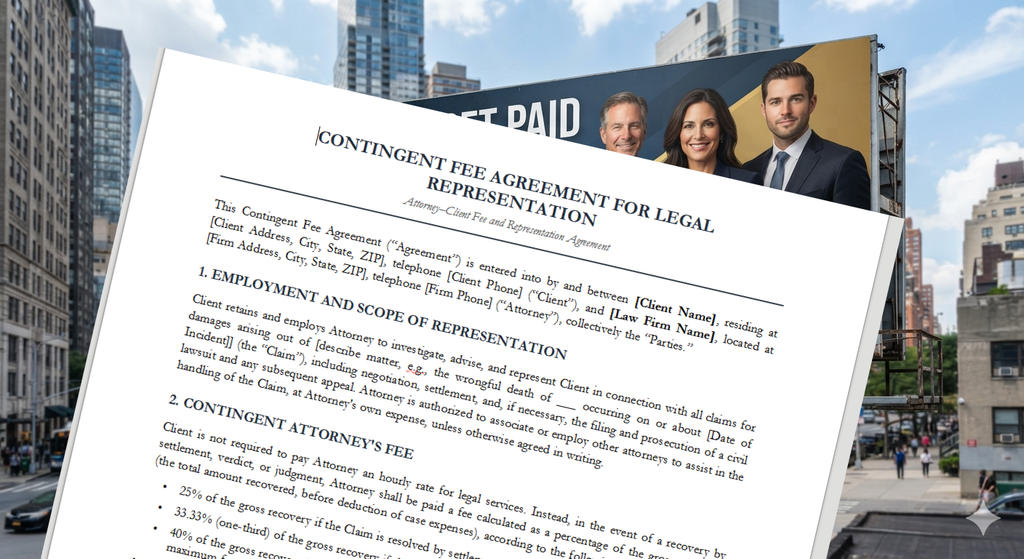
Reading a legal agreement for the first time, usually across a desk from the lawyer, is intimidating. It helps to see what a standard agreement looks like before the meeting. This link takes you to a sample Contingent Fee Contract.
https://lawcheck.net/wp-content/uploads/2026/11/Sample_Contingent_Fee_Agreement.pdf
Review the agreement to see how the math is structured, and learn what clauses to look for before you sit down with an attorney.https://lawcheck.net/wp-content/uploads/2026/11/Sample_Contingent_Fee_Agreement.pdf
Frequently Asked Questions
Do I owe my lawyer anything if I lose a contingent fee case?
You typically owe no attorney fee, but you may still owe case expenses depending on your contract. Always ask this question directly before signing.
Can I negotiate a contingent fee?
Often, yes. Percentages are not set by law in most places, and some lawyers will adjust the rate, especially for strong cases with clear liability. It never hurts to ask.
Is a contingent fee better than an hourly fee?
It depends. Contingent fees work well when you’re seeking money damages and can’t afford hourly billing. For cases where there’s no money recovery, such as many family law matters, hourly or flat fees are more common.
Should I talk to more than one lawyer?
Yes. Most personal injury lawyers offer free consultations, so you can compare fee structures and expense policies.
The Bottom Line
“No win, no fee” is not the same as “no cost.” Contingent fees can give people access to legal help they couldn’t otherwise afford, but the details, especially around expenses and how the fee is calculated, can change what you walk away with. Read the agreement carefully, ask questions, and get familiar with a sample contract before you sign.
This article is for general informational purposes only and is not legal advice. Fee rules and requirements vary by state, so consult a licensed attorney about your situation.



0 Comments